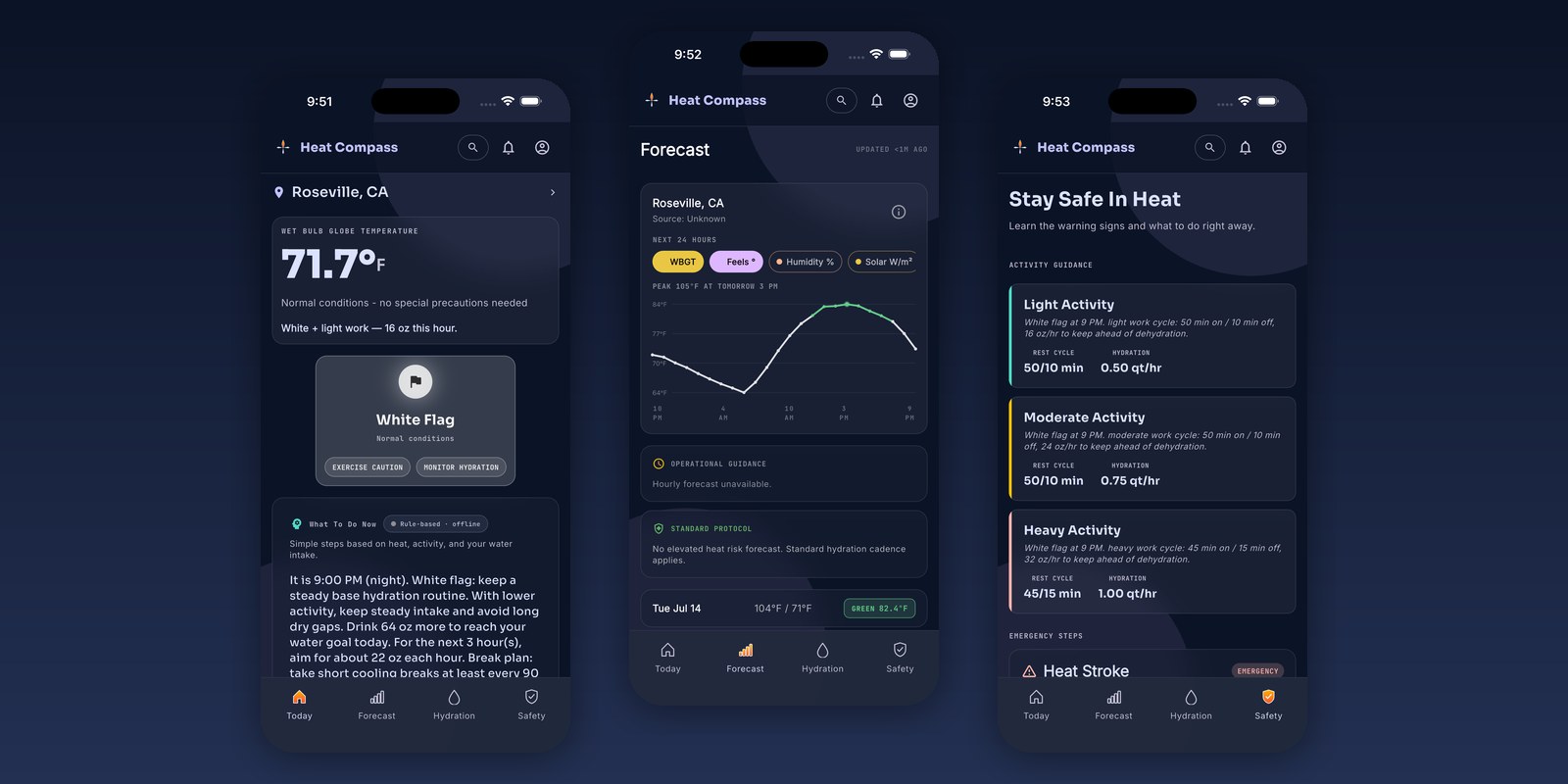
What it is
Heat Compass turns the U.S. Marine Corps five-color heat-flag system into a personal safety coach. It computes wet-bulb globe temperature from live weather for wherever you are, shows the flag (White through Black), and tells you plainly what that means: how long to work, how long to rest, how much to drink. A 7-day heat forecast, adaptive hydration reminders, and proactive flag-change alerts round it out. No account; a guest’s data never leaves the phone.
The iOS app went to App Review in July 2026. An enterprise console edition for crews and worksites lives at heatcompass.com.
The formula audit
Before submitting, I had the entire scientific core verified against the published sources: Stull’s 2011 wet-bulb approximation coefficient by coefficient, the USMC flag thresholds, TB MED 507’s fluid limits, the NWS heat-index regression, the haversine station distances.
Most of it was exact. Three things were not, and each was the kind of bug that matters in a safety app: the headline “outdoor” WBGT was numerically a shade WBGT that under-read by one to two flag levels in full sun; a string mismatch served White-flag advice during Black-flag conditions; and the hydration guidance had no ceiling, so a user far behind at 11 PM could be told to drink 90 ounces in an hour. All fixed and locked behind golden-value tests before any user saw them. A safety tool should show its work.
How it works
- Deterministic, offline guidance: USMC-derived rules generate the coaching; no cloud calls, no model, instant with no connection
- Transparent sourcing: weather comes from the National Weather Service with Open-Meteo fallback, and the UI always says which station a reading came from, how far away it is, and how old it is
- Honest solar: when a source carries no radiation measurement, a clear-sky solar-position estimate stands in, so a midnight reading no longer assumes full sun
- Bounded advice: hydration coaching caps at 32 oz per hour and 12 quarts per day, per military heat-illness doctrine, and says out loud that over-drinking is also dangerous
- Consumer + enterprise: the iPhone app for individuals, plus a console edition for organizations managing heat risk across people and sites
Why it matters
Heat kills more people in the U.S. than any other weather. The doctrine that protects soldiers and outdoor crews is public; it just doesn’t live in anyone’s pocket. Getting it there honestly meant treating the formulas as the product and auditing them like it. Built end to end with Claude Code.
Where it led: the heat thread
HeatCompass is where my work on heat started. When the Google I/O hackathon ran a “heat effects” brief, I wanted to enter with it, but HeatCompass as it stood didn’t fit a weekend build, so I started fresh. That sparked Heat Threshold, a Gemini multi-agent heat-safety dashboard (the wrong thing, but a great showcase of Gemini’s Managed Agents), which in turn led to Heat Protein Lab, the molecular-science take I actually wanted. Three angles on the same question, what heat does, and how to stay ahead of it, from your pocket, a route, and a protein.