What it is
Heat Protein Lab is an interactive, browser-based lab for watching what heat does to proteins: denaturation, the heat-shock response, and the molecular machinery (HSF1 and friends) that cells use to survive it. You scroll down a temperature gradient, one “plate” at a time, and the molecules respond.
Open the lab → heat-protein-lab.pages.dev
The thing I built after the wrong thing
I didn’t build this at the Google I/O hackathon. At the hackathon I built Heat Threshold, an ambitious, multi-agent heat-safety dashboard that scheduled outdoor activity around wet-bulb risk. It worked, and it was the wrong thing: I’d answered a logistics question when the idea I actually cared about was the science, what heat does at the molecular level.
So afterward I rebuilt the heat idea from scratch, the way it should have been told the first time: not a swarm of agents, but a quiet, legible walk through one real protein.
How it works
It wires a set of small, independently-testable scientific skills, structure rendering, denaturation modelling, metrics, charting, into one coherent pipeline an AI agent can drive. Each step is traceable; the prose is held to the same standard as the code.
- A denaturation view that animates structural unfolding as temperature climbs
- Real structures, not cartoons, e.g. PDB
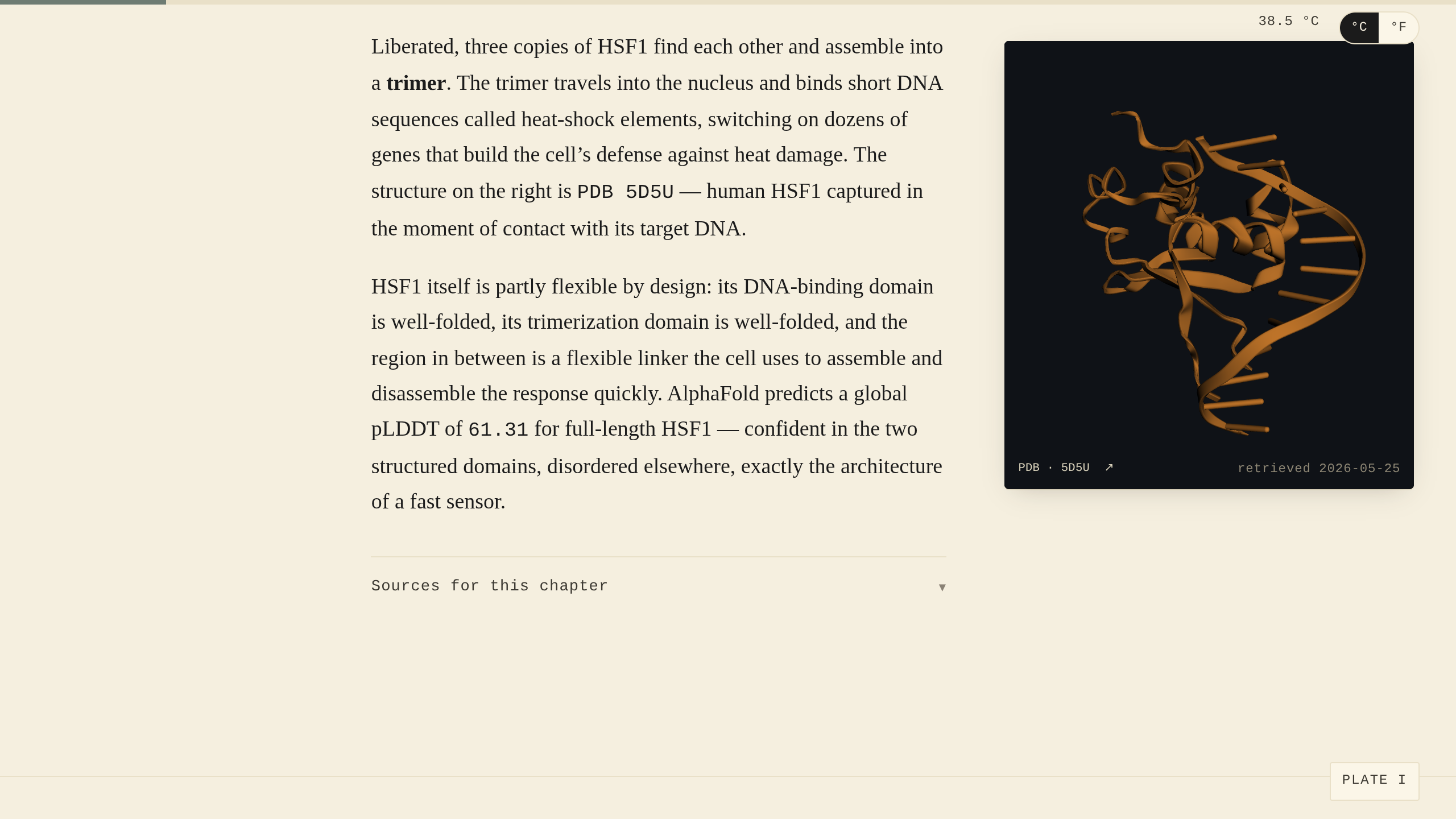
5D5U, HSF1 captured in contact with its DNA heat-shock element, with AlphaFold confidence shown honestly (pLDDT 61.31 for the flexible linker, not hidden) - A chart skill strict enough to catch its own design bugs
Why it matters
Same thesis as the rest of my work: one person, paired with the right agent toolchain, can build a legible, inspectable system fast, even in a domain (structural biology) that isn’t my day job. But the real lesson is the pivot: I built the wrong thing first (Heat Threshold), recognized it, and used what I learned to build the right one.
It’s the third angle on a question I keep circling, what heat does, and how to stay ahead of it, after HeatCompass (from your pocket) and Heat Threshold (from the route). This one’s from the molecule.