An airman died after a rappelling fall at the Alamodome on October 17. I do not know the equipment involved or what failed. These are eight speculative concepts for catching a rappeller who loses control, from someone outside the field.
On Saturday, October 17, an Air Force airman fell while rappelling from the rafters of the Alamodome during the pregame ceremony before UTSA played Navy. He died of his injuries at a local hospital. The Air Force says the details remain under investigation.
I do not know what went wrong, and nothing on this page is a guess about it. I also came to this with zero knowledge of the systems that already exist to keep people safe on a rope. I have no background in rope access, rescue, or fall protection. What follows is speculation from outside the field, written down so that people who do know it can say where it breaks.
The question was how a rappeller who loses control could still be caught. It started as one idea: two tethered prongs that launch around the main rope and grab it. I worked through it with Claude, which also drew the plates. The one idea became eight. Each is aimed at a different way a descent can go wrong, and each comes with the one unknown that would decide whether it is worth building.
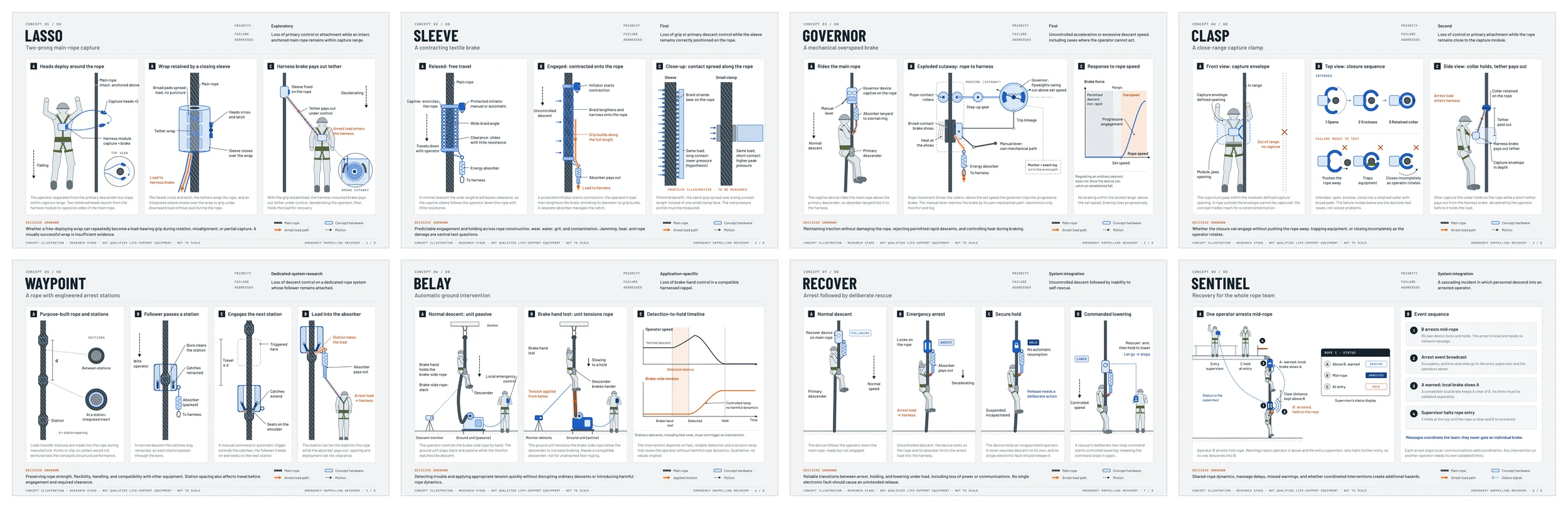
All eight plates. Each one below opens full size, and the set is also a PDF.
The eight concepts
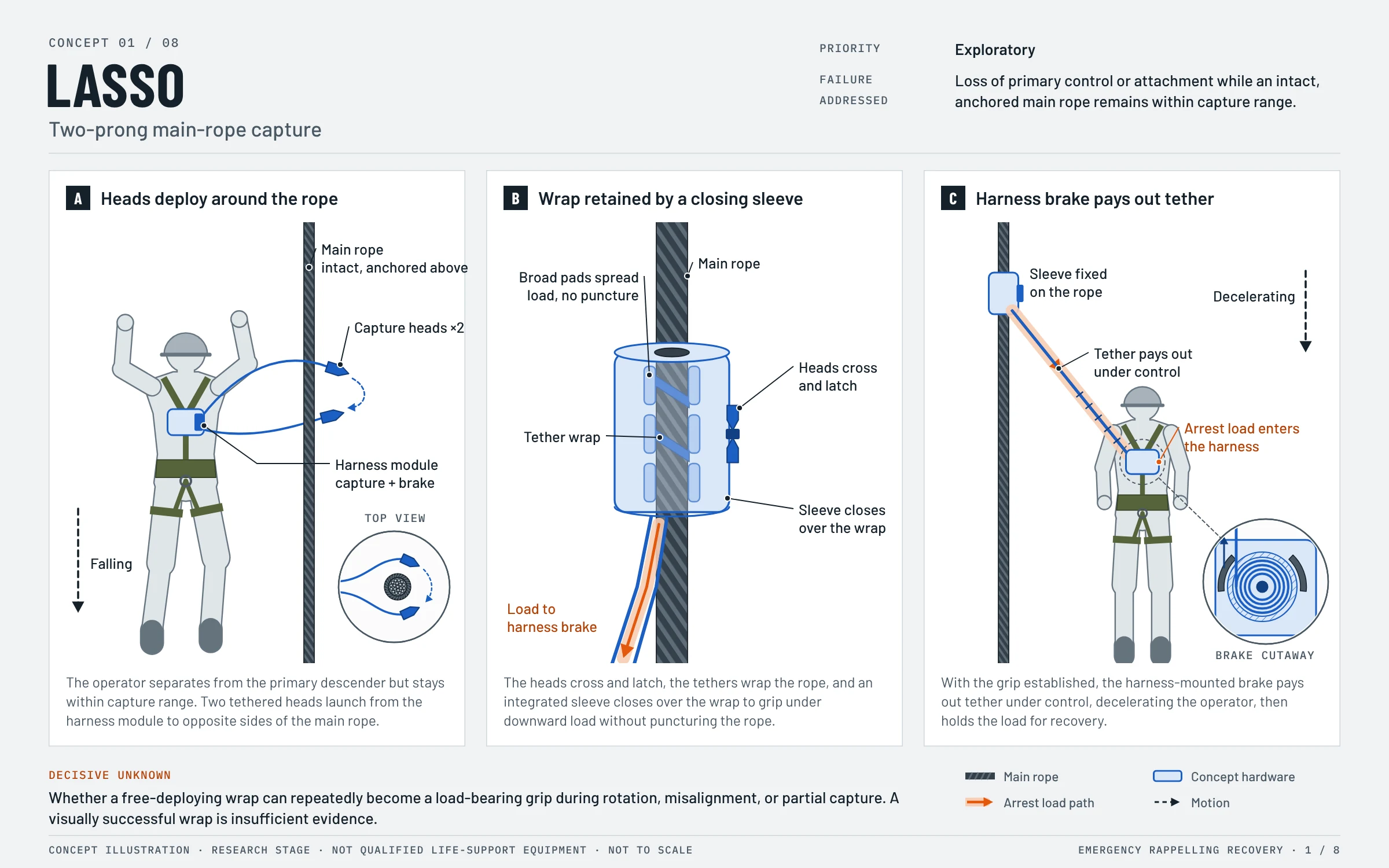
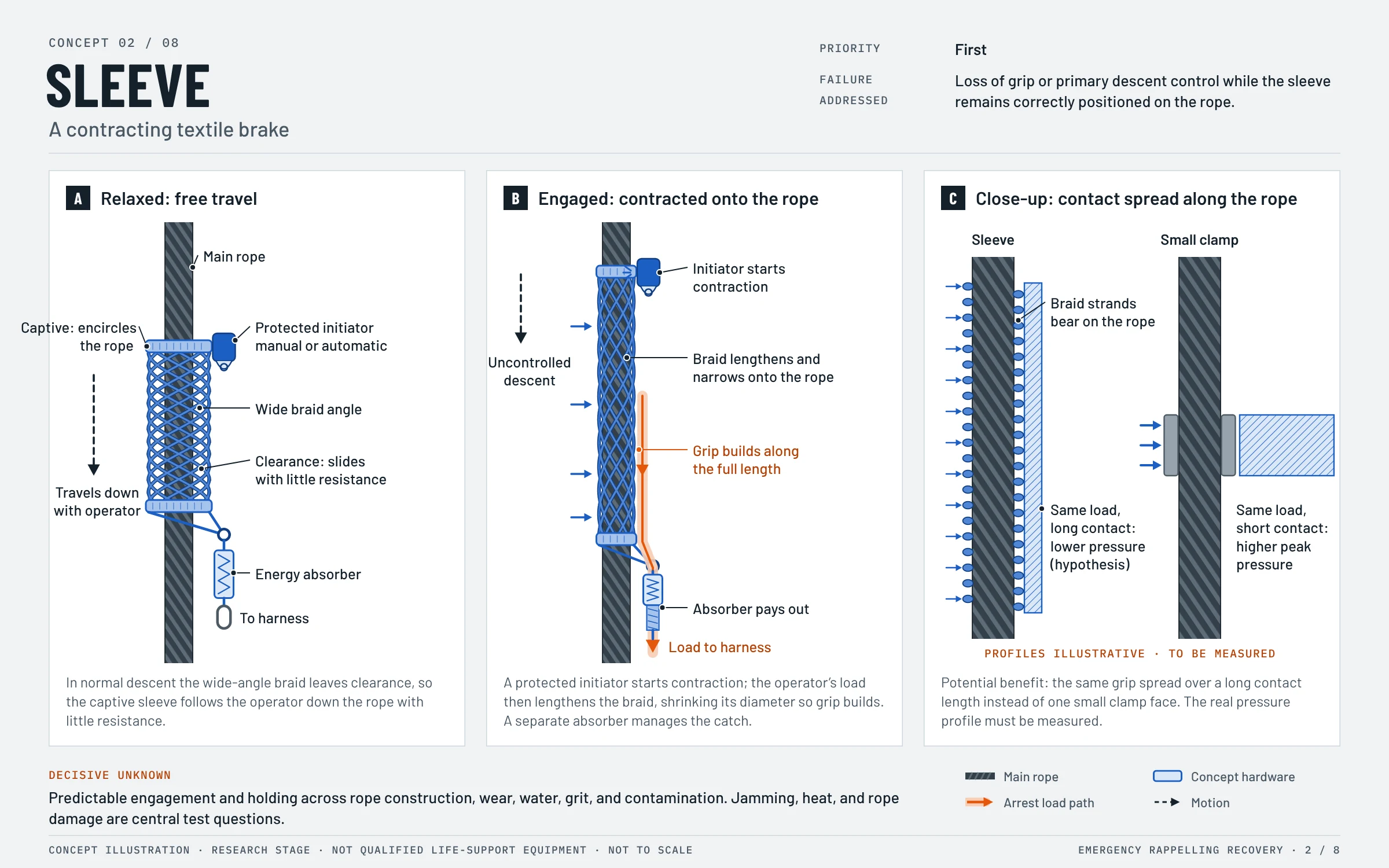
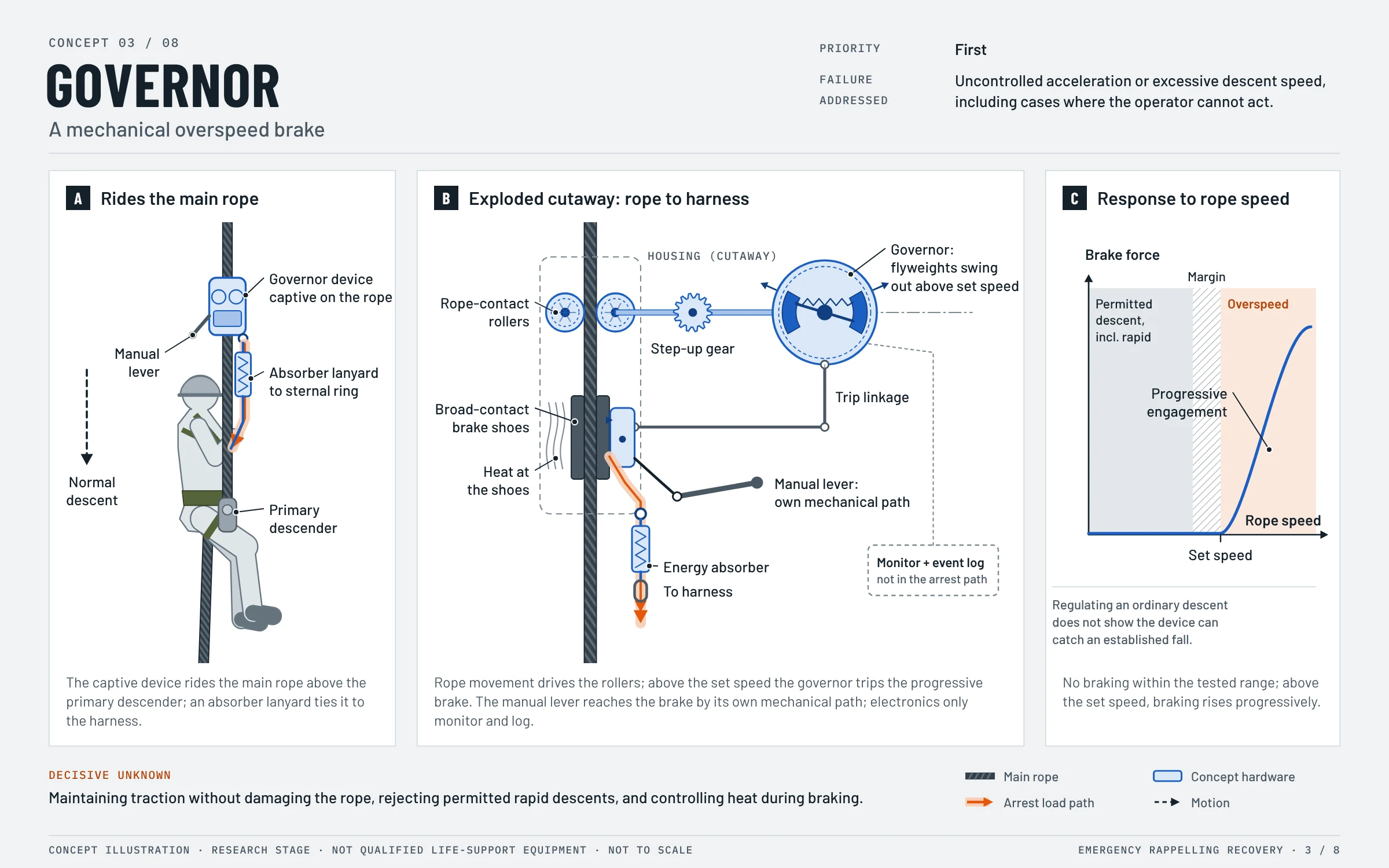
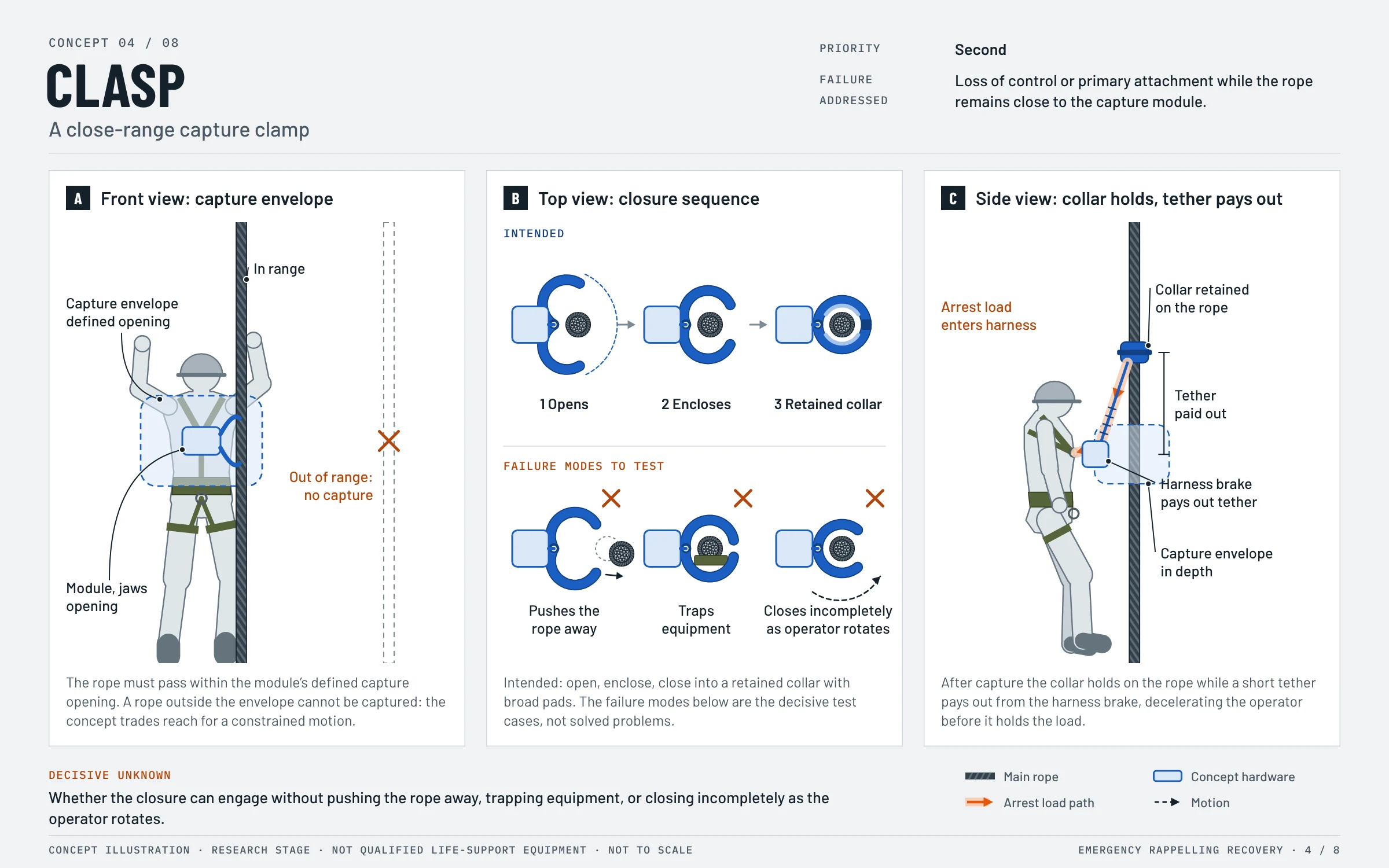
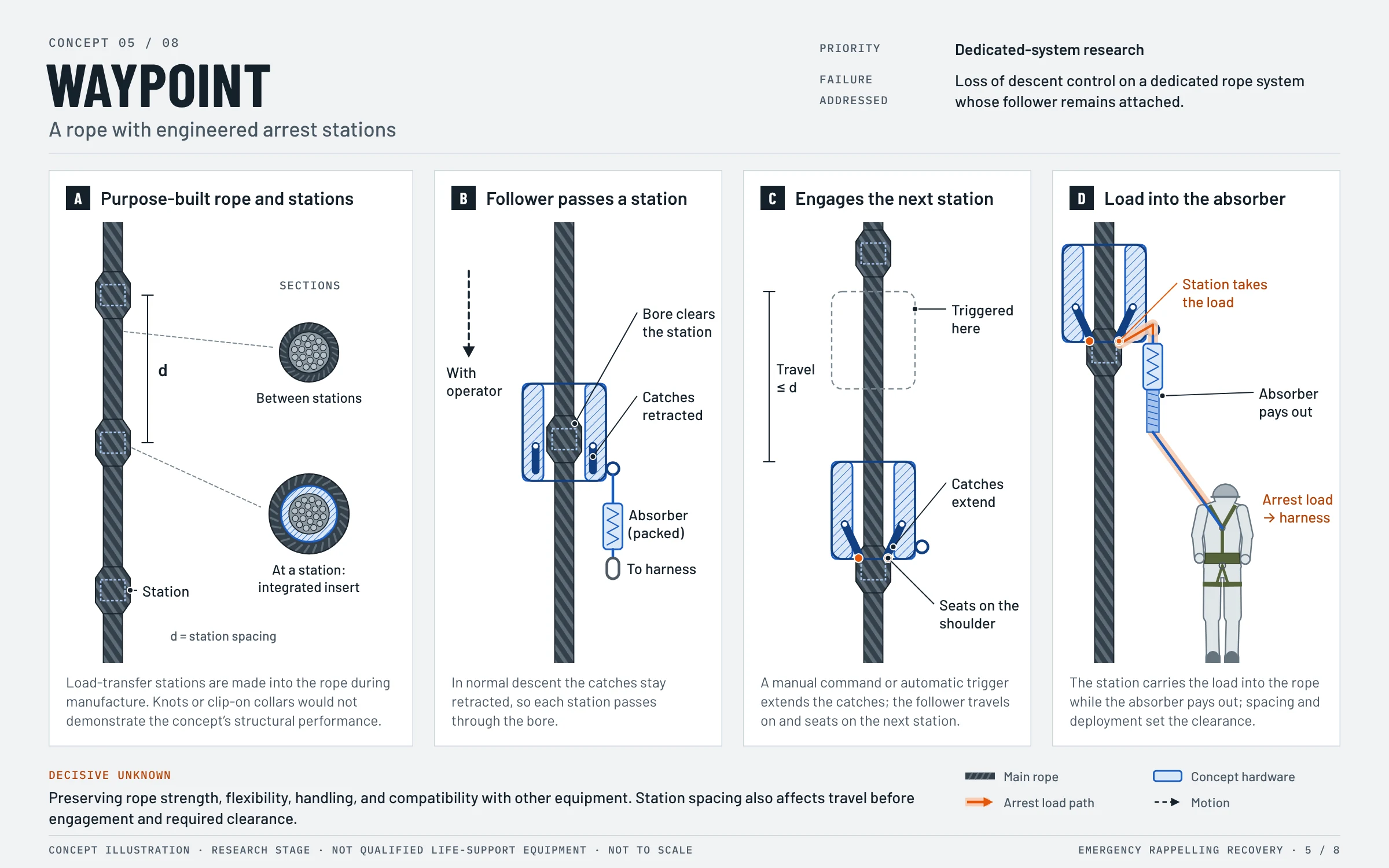
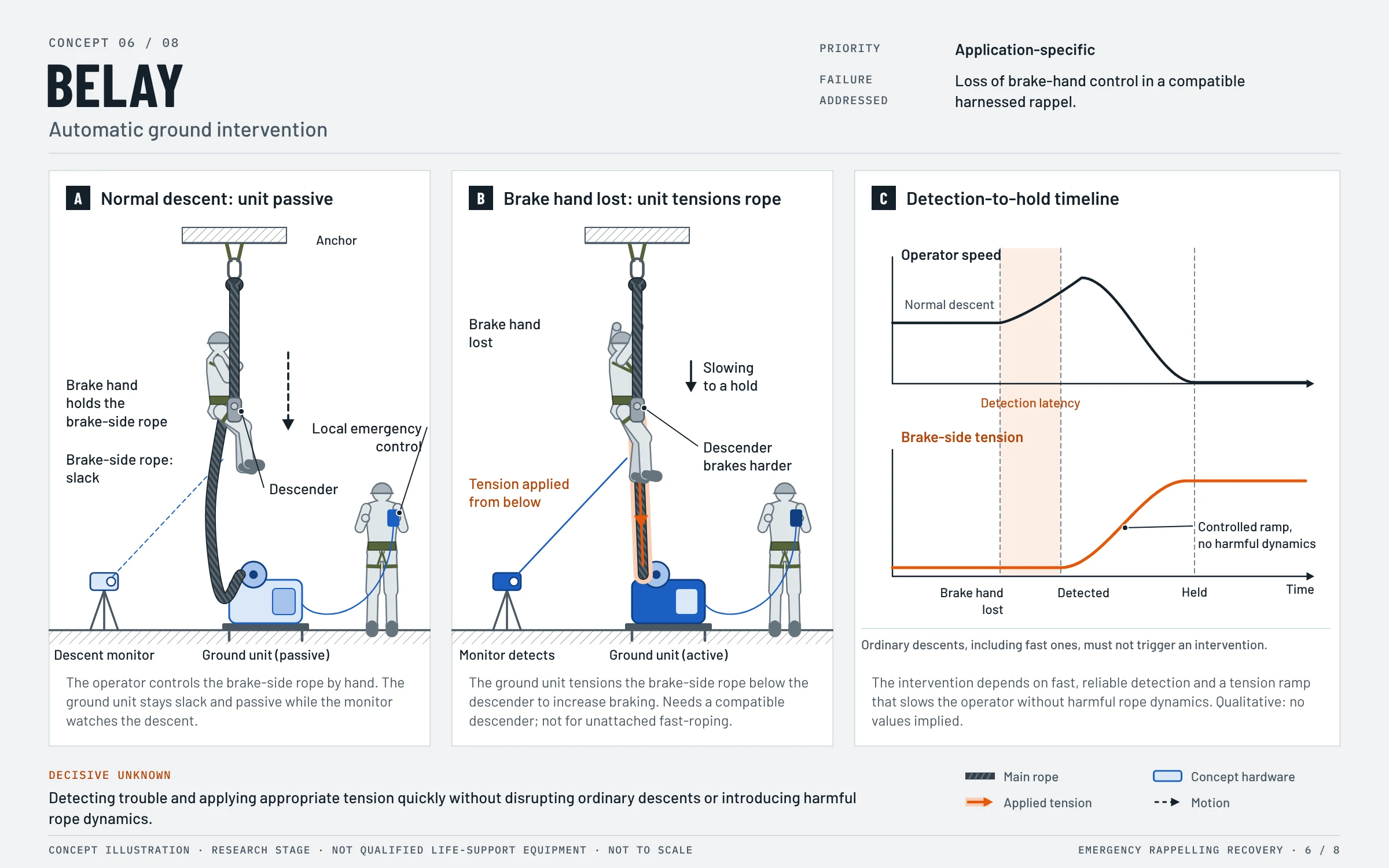
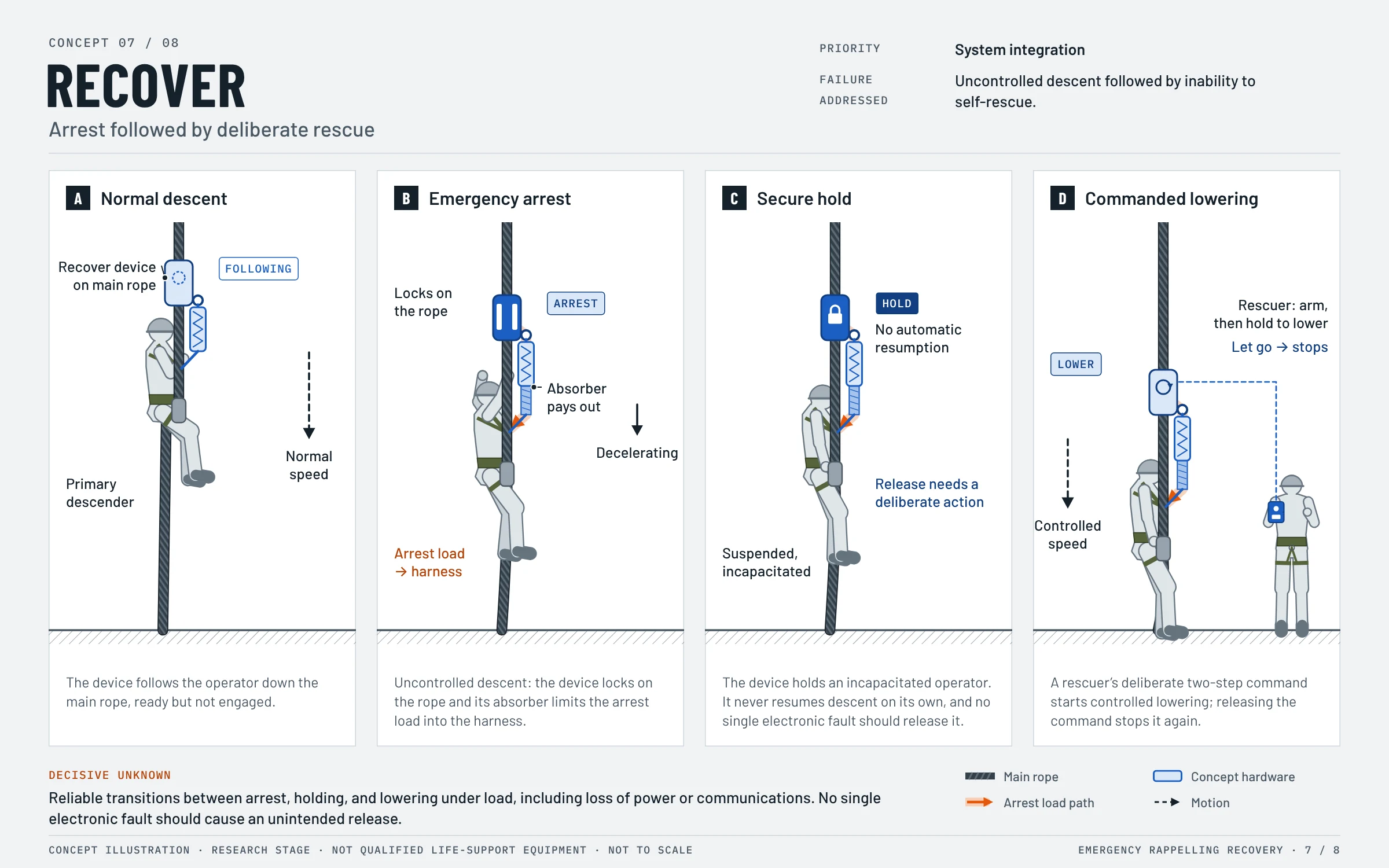
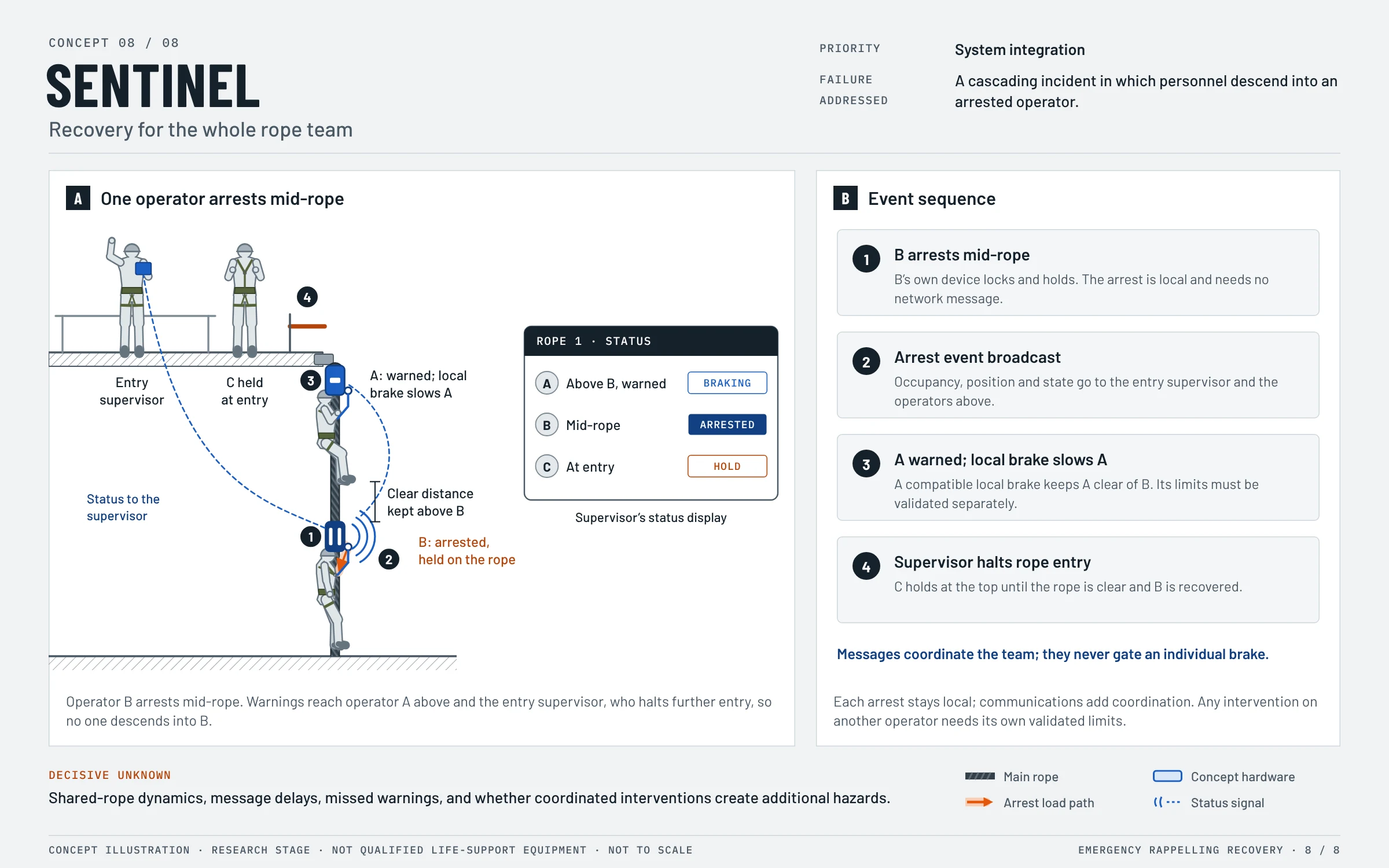
1. Lasso. Two tethered heads wrap the main rope and a sleeve closes over the wrap, then a brake on the harness pays out tether to slow the fall. The open question: can a wrap thrown through the air become a grip that holds load every time, even while the rappeller spins?2. Sleeve. A braided sleeve rides loosely on the rope and tightens like a finger trap once it is pulled. The open question: does it grip the same way on wet, gritty and worn rope, without jamming, overheating or damaging it?3. Governor. Rollers on the rope drive a mechanical speed sensor that trips a brake above a set speed. There is no battery in the arrest path, and a manual lever reaches the brake through its own linkage. The open question: enough traction to catch a fall without damaging the rope or overheating, while still allowing a fast descent that is intended.4. Clasp. A short-range clamp on the harness closes around a rope that is already close by and becomes a collar. It gives up reach in exchange for a simpler motion. The open question: can it close without pushing the rope away, trapping other gear, or closing halfway as the rappeller turns?5. Waypoint. A purpose-built rope with arrest points made into it during manufacture, and a follower that catches the next one on command. The open question: can the rope keep its strength, flexibility and handling with those points built in, and how far does the follower travel before it catches?6. Belay. A ground unit that automates the bottom belay: when a rappeller loses their brake hand, it pulls the brake side of the rope below the descender to slow them. It only works with a compatible descender, and not for fast-roping. The open question: detecting trouble fast enough without interfering with ordinary descents or creating harmful rope dynamics.7. Recover. Arrest, hold, and lower only when a rescuer deliberately commands it. The device never resumes the descent on its own. The open question: making sure no single fault, including lost power or communications, releases someone who is being held.8. Sentinel. When one rappeller is arrested, the people above are warned and the supervisor stops anyone else from starting down. Each brake still works without the network. The open question: whether message delays, missed warnings or coordinated braking create hazards of their own.
What I took from it
Grabbing the rope and stopping the person are two different problems. A device that grips the rope still needs a way to absorb the energy of the fall, and that load has to go into the harness.
Equipment that does parts of this already exists in industrial rope access, fall protection and military fast-roping gear. None of it shows these ideas work, but it is where a real attempt would start.
The first experiments are mechanical: does the grip engage every time, does the rope survive it, and does the load reach a controlled brake. Everything else waits on those answers.
A rappeller who has been stopped on a shared rope becomes an obstacle for whoever is coming down next.
None of this is qualified life-safety equipment, and none of it says anything about what happened on Saturday. If you work in rope access, rescue, or military insertion and can see where these ideas break, I would like to hear from you.
Craig Merry is a hard-of-hearing developer in Sacramento, California. By day he is a SharePoint developer and administrator; on the side he builds open-source robotics on low-cost hardware. He has no background in rope access or fall protection.
If you know rope access, tell me where this breaks.
Rope-access technicians, rescue engineers and anyone who trains insertion teams: a note on what is wrong here, or already solved, is the most useful thing this page can get.