What it is
On 7 September 2026 a senior robotics researcher posted a challenge on X: language models are good at planning, but can you prompt one to output the high frequency control commands for a legged robot in varying terrain, the kind of thing learned locomotion policies were doing five years ago (RSS 2021, CoRL 2022)? I had the pieces to test it that evening: a Pollen Microduck, a verified MuJoCo plant of it in my bench, and the robot’s own trained walking policy to compare against. So I ran it, pairing with Claude Code, and published the result as a page with every episode attached.
How it works
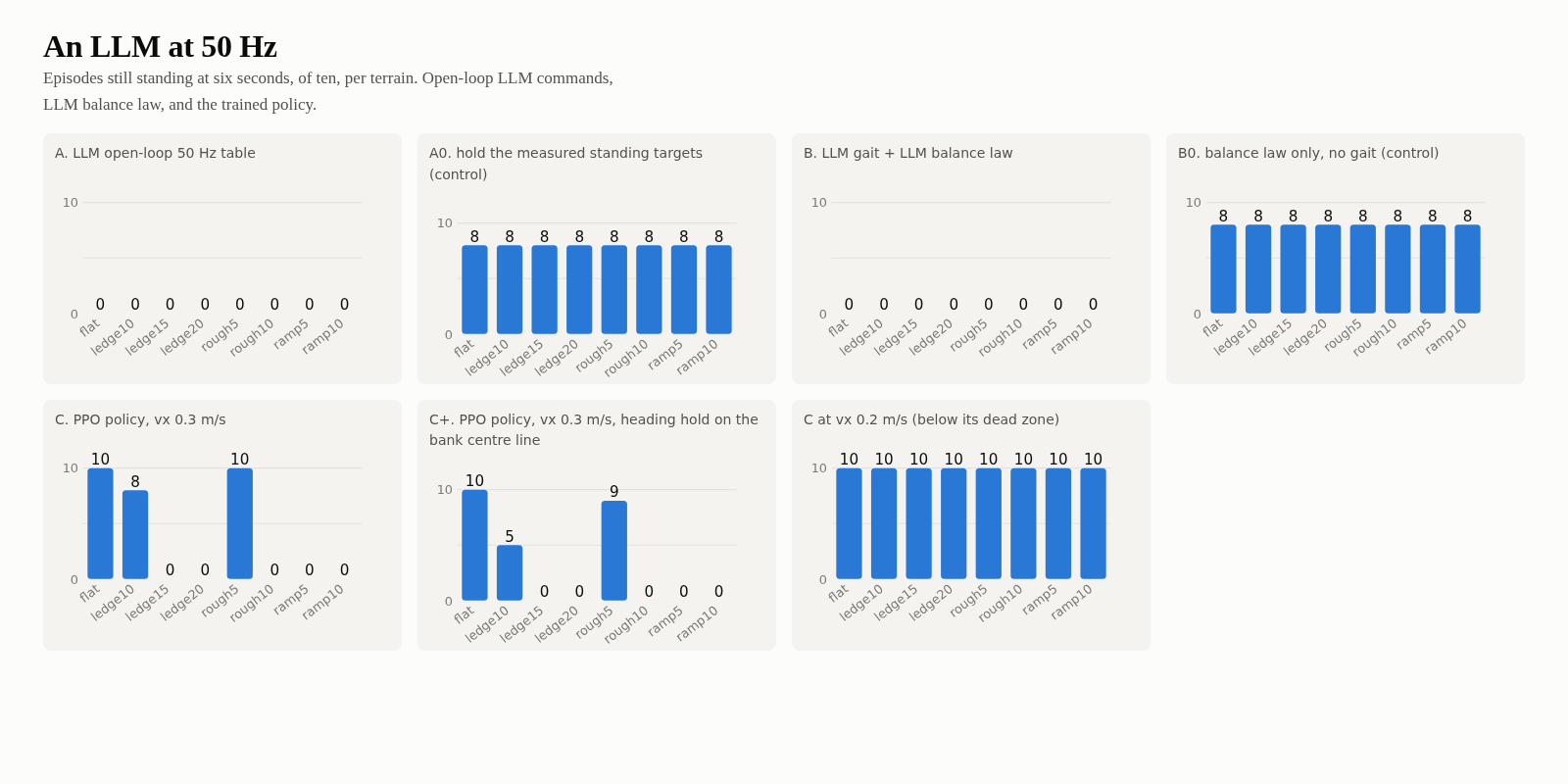
Three controllers on the same plant, eight terrains, ten perturbed starts each.
The first is the challenge as posed. Claude wrote a parametric walking gait by hand and expanded it into a literal table of fourteen servo targets every 20 milliseconds. Nothing reads a sensor after the first tick. Its five parameters were tuned on the flat floor with a 72-point grid and then frozen.
The second is the same gait with a balance law the model also wrote: projected gravity and the gyro feed hip pitch and roll every tick. That is the “code as policy” reading of the question.
The third is the robot maker’s trained PPO policy, 50 Hz, 61 proprioceptive inputs, run through the bench’s canonical loop with a 0.3 m/s command and no tuning.
The terrains are laid from the bench’s bank of movable blocks: a flat floor, single ledges of 10, 15 and 20 mm, two rough sequences, two ramps. Pollen trains this robot on steps capped at 15 mm because, in their words, it can only lift its feet one to two centimetres. The terrains bracket that.
What came out
The open-loop table never stood for six seconds, on any terrain, including the flat floor. The balance law can hold a stand but the moment the gait starts it falls. The trained policy walked every flat and 5 mm run, eight of ten over a 10 mm ledge, and none over 15 mm: it trips at the first riser past what it has ever felt, mid-lane, in every seed. That is exactly the gap the CoRL 2022 paper closes with a camera.
Two things the model found on the way were worth more than the gait. Holding the robot’s nominal pose on its position servos falls in 0.64 seconds with no feedback, so any open-loop motion has to ride on the pose the trained policy actually asks for, which I measured. And the policy has a command dead zone: at 0.2 m/s it stands still and scores a perfect ten of ten on every terrain, which would have made a naive comparison lie.
Why it matters
The post I was answering ended by saying language models are useful for planning and for assisting a robotics researcher. That is what this afternoon looked like from the inside. The model wrote the terrain generator, the kinematic sign probe, the episode harness, the controls and the analysis, and it found the two artefacts above. What it could not do, with a simulator in the loop and a hundred rollouts of tuning, was the 50 Hz loop itself.
I published the negative with the same care I would give a positive: the tuning grids in full, the two controls, the limitations stated plainly (simulation only, a 25 cm toy biped rather than the robots in the cited papers, a borrowed baseline rather than a reimplementation), and the data down to every tick of every episode.