What it is
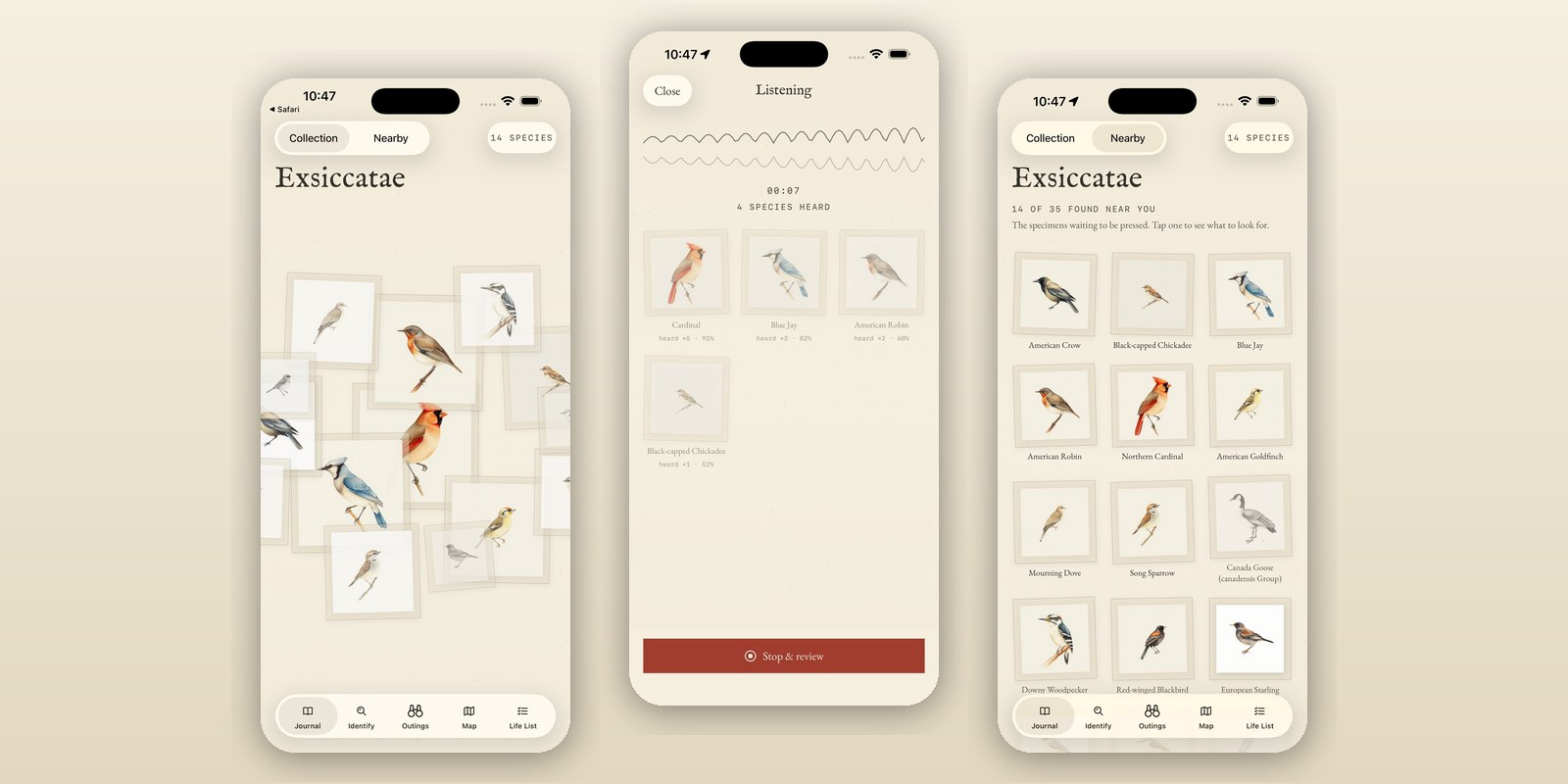
Exsiccatae is a bird-detection field journal for iPhone. Point the camera at a bird or let the microphone listen for one, and the species appears in your journal, painted in watercolor on a herbarium mounting sheet. The more often you meet a species, the more fully its plate paints itself in. An “exsiccata” is a bound collection of pressed specimens; this is one for moments instead of plants.
It is free, has no account, and does all of its identification on the phone. Outings can be exported in eBird’s record format so your walks can contribute to Cornell’s citizen-science dataset, on your terms: the app never submits anything for you.
How it works
- Photo ID runs an EfficientNet classifier converted to Core ML; song ID runs a 6,522-species audio model, also fully on-device.
- The audio model conversion was the fun part. The only operation Core ML could not translate was a complex-valued FFT, and the model only ever used its real half, which is just a matrix of cosines. Swapping the FFT for that matmul made the whole network convert, verified against the reference implementation.
- The herbarium look is a design system, not a skin: golden-angle collage layout, two-voice determination slips, plates that sharpen from pencil to full watercolor as your sightings accumulate.
- Species metadata resolves against the GBIF backbone taxonomy, and traveling outings measure distance with plain CoreLocation, the same way eBird defines it.
Why it matters
Most identification apps treat the phone as a thin client for a cloud model. This one treats the phone as the whole instrument, which changes what you can promise people: your photos, sound clips, and locations stay yours. It is also the project where my pipeline (xcodegen, headless archive and upload, App Store Connect entirely by API) matured to the point that the next three apps shipped in days. Built end to end with Claude Code.